By Jim Farber
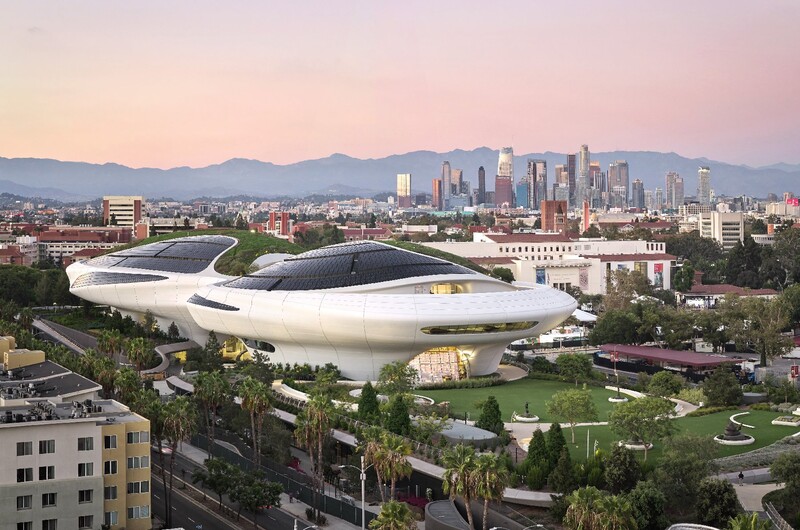
It seems only appropriate that the Lucas Museum of Narrative Art, which has just opened to the public, is a sleek 300,000-square-foot building designed by Ma Yansong of MAD Architects that resembles an intergalactic starship. It's also appropriate that the museum's location on 11 acres in Exposition Park is directly across the street from the University of Southern California's School of Cinematic Arts, where George Lucas (and his fellow student Steven Spielberg) honed their craft.
Destined to become a major tourist attraction, the museum's collection is as diverse as its goal, to celebrate storytelling and particularly the art of illustration — from "The Mad Tea Party" in Lewis Carroll's "Alice's Adventure in Wonderland" to the hit-and-run wall art of Banksy.
In fact, this is almost certainly the only major museum in the world that presents works by renowned artists such as Frida Kahlo, Diego Rivera, Mary Cassatt, Fernand Leger, Thomas Hart Benton, Dorothea Lange, Kara Walker and Frederic Remington adjacent to galleries devoted to "What me worry?" MAD magazine cover art, paintings of muscular women warriors by Frank Frazetta, Charles Schulz's panels for "Peanuts," and a 1902 storyboard by Georges Melies for his pioneering silent film "A Trip to the Moon," juxtaposed with Mel Ramos' "Man of Steel" and Andy Warhol's "Howdy Doody."
And since every "Star Wars" fan expects it, a capacious gallery is devoted to the full scope of the "galaxy far, far away" franchise, with R2-D2 and C-3PO there to greet you. You'll find cinema-scaled dioramas and come face to face with life-size replicas of Darth Vader, Princes Leia and Luke Skywalker along with speeders, lightsabers, production models and artist renderings.
After entering the futuristic structure, visitors are encouraged to experience a multimedia guide that traces the history of narrative art from cave painting to making the jump to light speed. Then it's time to take one of the see-through tubular elevators to the fourth floor, where the bulk of the collection resides in a curvilinear labyrinth of thematically titled galleries that extend the entire length of the building, ending in vista points that offer panoramic views of Los Angeles. There's also a rooftop garden walkway and, for fine dining, the Skywalker Grill with its outdoor patio (reservations required).
The gallery themes include History, Children's Stories, Love and Family, Everyday Life and Civic Life, The American West, Romance and Adventure, Science Fiction and Fantasy, and Graphic Stories. Each display presents a mix-and-match of eras, mediums and visual messaging.
Grasping it, however, is complicated by an absence of wall text that traditionally provides biographical and historical context. Instead, this level of detailed information is only accessible by scanning each artwork with your phone. Or you can buy the catalog in its various configurations, from pocket-size to a deluxe two-volume boxed set published by Taschen available in the gift shop for $200.
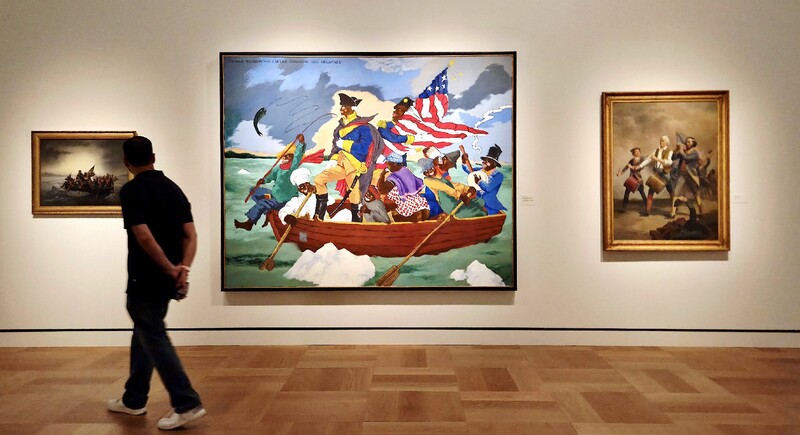
The History galleries offer the most provocative juxtapositions, my favorite being Robert Colescott's scathing satire, "George Washington Carver Crossing the Delaware: Page From an American History Textbook," flanked by a replica of the original 1851 painting by Emanuel Leutze (in the National Gallery) and a copy of Archibald Willard's "The Spirit of '76."
Given ample space for multiple examples, the monograph galleries stand out devoted to illustrative work by Maxfield Parrish, Norman Rockwell, Thomas Hart Benton, N.C. Wyeth, Jessie Wilcox Smith and Frazetta.
The museum's crown jewel, however, is the riveting gaze of Kahlo's self-portrait, "Autorretrato dedicado al Dr. Eloesser," painted in 1940.
As Lucas explains in the museum's catalog, "I love art of all kinds. ... The Lucas Museum of Narrative Art was created to honor humanity's stories and the artists who illustrate them. The artists in this collection didn't just create images, they connected our modern imaginations with our ancient emotions — with common beliefs creating community. Their work spans genres, media and time."
Be prepared to spend an entire day.
WHEN YOU GO
The Lucas Museum of Narrative Art: lucasmuseum.org
Jim Farber is a freelance writer. To read features by other Creators Syndicate writers and cartoonists, visit the Creators Syndicate website at www.creators.com.
The new Lucas Museum of Narrative Art, designed by Ma Yansong of MAD Architects, resembles a starship. Photo by Hufton+Crow, courtesy of the Lucas Museum of Narrative Art.






View Comments