Dear James: We are going to need more storage space with a new baby. Adding a small linen closet inside an existing closet would help. Do you have any tips on adding closets? — Anthony R.
Dear Anthony: A house can never have too much storage space, especially with a growing family. A linen closet with many shallow shelves or drawers makes an efficient use of space. Of course, once you convert a closet to be used for linens, you will have to replace that lost closet space somehow.
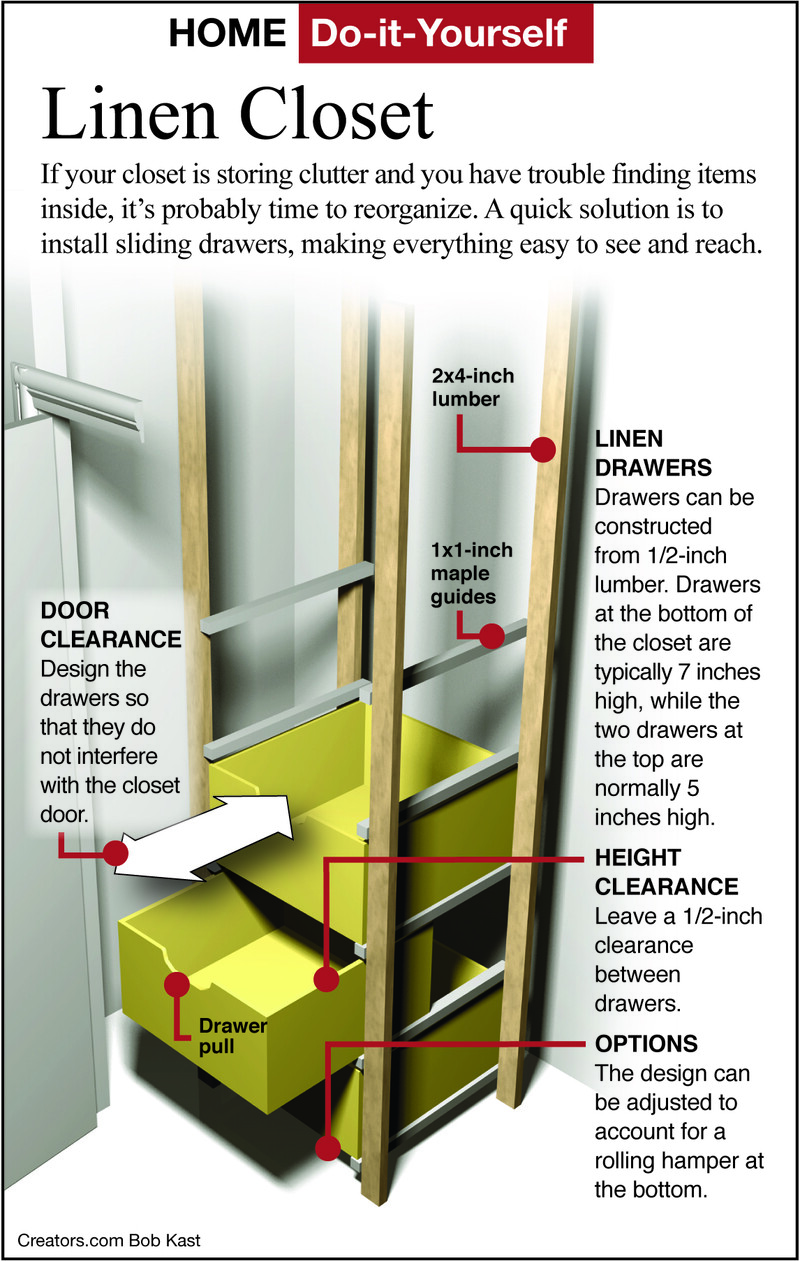
Adding sliding drawers to an existing closet is an excellent do-it-yourself method to create a functional linen closet. Just installing shelves in a closet is probably a bit easier, but installing drawers looks more professional and forces you to keep the closet better organized with everything in its place. With shelves, it is often tempting to just toss something on the most convenient open space.
Select an existing closet which is not much wider inside than the width of the door opening so less space on the sides is wasted. The drawers will extend out the door when you pull them open, so their width is limited to the width of the door opening.
If the closet is considerably wider than the door opening, make the drawers narrower than the door opening and offset them to one side. This will give you easier access to the open space on the side to store tall, narrow items such as a broom, vacuum cleaner wand, etc. Also consider making the drawers shorter for better access to the side storage.
Once you decide on the width and length of the drawers, begin to build them with 1/2-inch lumber. A 7-inch depth is effective for most linens, but you may want to make one or two of them a little deeper. Stop them about 2 feet from the floor. This will provide room to store a rolling hamper, vacuum cleaner or other short items.
The simplest method to build the shelf supports is to nail two-by-fours, two on each side, from the floor to the ceiling. Mount one-by-one maple supports horizontally to the two-by-fours. Space these supports 1/2-inch farther apart than the depth of the drawers. The door bottoms will slide on these supports.
There are many methods to build an additional closet, but the easiest way is using folding doors. These will hang from the ceiling on tracks in the corner of a room. Any type of folding doors will work and some are quite attractive.
Make triangular shelves that fit into the corner. The folding doors will be attached to the ceiling at a 45-degree angle to cover the shelves when the doors are closed. For a little fancier appearance, install flexible folding doors that hang from the circular track on the ceiling. When using this design, the shelves are shaped as quarter circles for more shelf area.
Use a stud finder to make sure the shelf supports are screwed into wall studs and not just the drywall. If they are in just the drywall, they may feel secure at first, but they will eventually loosen with use.





View Comments